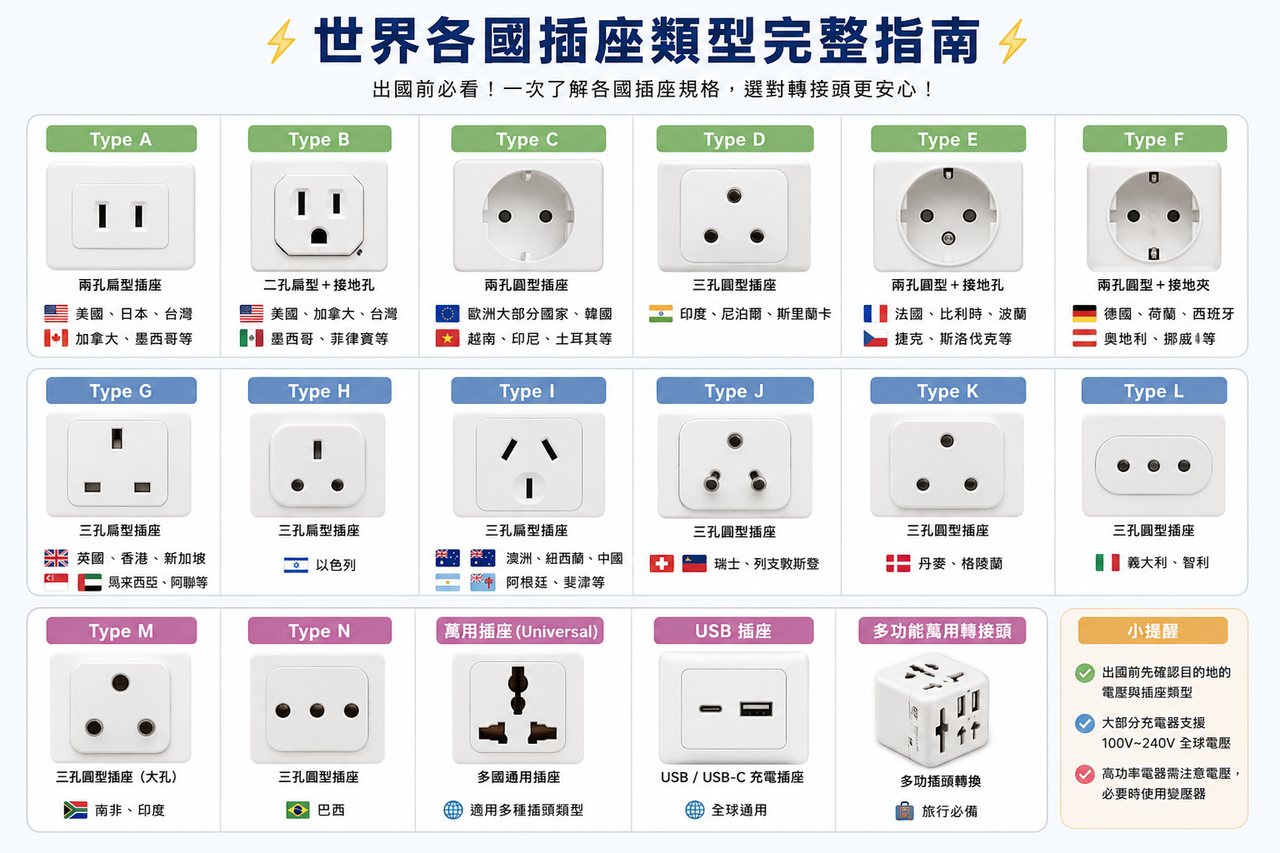
Before traveling abroad, most people check their passport, flights, hotel, and luggage. But many travelers forget one small detail that can cause real trouble: the voltage and plug type at the destination.
Some people arrive at the hotel and find that their charger does not fit the wall socket. Others damage a hair dryer or appliance because the voltage is not compatible. This guide summarizes the voltage, frequency, and socket types for popular travel destinations, plus when you need a travel adapter or transformer.
Why Check Voltage and Plug Types Before Traveling?
Power systems are different around the world. The socket shape may be different, and the voltage and frequency can also vary.
- Your plug may not fit the wall socket
- Your charger may need an adapter
- A hair dryer may not work correctly
- An appliance may be damaged by the wrong voltage
With laptops, cameras, power banks, and many electronic devices now common on trips, checking power specifications before departure can prevent a lot of stress. Buying an adapter at the airport or after arrival is often more expensive, so preparing early is usually better.
Taiwan Voltage and Socket Type
- Voltage: 110V
- Frequency: 60Hz
- Common sockets: Type A and Type B
Most phone, tablet, and laptop chargers used in Taiwan support worldwide voltage, so they usually do not need a transformer. However, high-power appliances still require extra attention.
Voltage and Socket Types by Country
Japan
- Voltage: 100V
- Frequency: 50Hz in Tokyo, 60Hz in Osaka
- Socket: Type A
Japan uses a plug type similar to Taiwan, so many Taiwan plugs can be used directly.
South Korea
- Voltage: 220V
- Frequency: 60Hz
- Socket: Type C and Type F
Korea uses European-style sockets. Bring a European adapter when visiting Seoul, Busan, or Jeju.
United States
- Voltage: 120V
- Frequency: 60Hz
- Socket: Type A and Type B
The power system is close to Taiwan, and most Taiwan devices can be used without a transformer.
Canada
- Voltage: 120V
- Frequency: 60Hz
- Socket: Type A and Type B
Canada uses the same common standard as the United States.
China
- Voltage: 220V
- Frequency: 50Hz
- Socket: Type A, Type C, and Type I
Some hotels provide universal sockets, but carrying a universal travel adapter is safer.
Hong Kong and Macau
- Voltage: 220V
- Frequency: 50Hz
- Socket: Type G
Both destinations use the UK-style three-pin socket. Prepare a Type G adapter.
Singapore and Malaysia
- Voltage: 230V to 240V
- Frequency: 50Hz
- Socket: Type G
These countries use UK-style sockets, so a Type G adapter is needed.
Thailand
- Voltage: 220V
- Frequency: 50Hz
- Socket: Type A, Type B, and Type C
Some hotels can accept Taiwan plugs, but a universal adapter is still recommended.
Vietnam
- Voltage: 220V
- Frequency: 50Hz
- Socket: Type A and Type C
Many hotels can accept Taiwan plugs, but carrying an adapter is more convenient.
United Kingdom
- Voltage: 230V
- Frequency: 50Hz
- Socket: Type G
The UK uses a different plug type from most Asian countries. Bring a Type G adapter.
France
- Voltage: 230V
- Frequency: 50Hz
- Socket: Type C and Type E
A common European travel adapter is usually suitable.
Germany
- Voltage: 230V
- Frequency: 50Hz
- Socket: Type C and Type F
Germany uses the common European standard. Prepare a European adapter.
Italy
- Voltage: 230V
- Frequency: 50Hz
- Socket: Type C, Type F, and Type L
Some areas still use Type L. A universal international adapter is the easiest option.
Do Phone Chargers Need a Transformer?
Usually, no. Most modern phone, tablet, and laptop chargers support worldwide voltage. Check the label on the charger. If it says Input: 100-240V, it can usually be used in most countries. You only need the correct plug adapter.
Which Appliances Are Most Easily Damaged by Voltage Differences?
High-power appliances need special attention, including hair dryers, curling irons, electric kettles, heated blankets, heaters, and electric cookers.
If these appliances are used with an incompatible voltage, they may overheat, fail to operate, blow a fuse, or become permanently damaged. Always check the supported voltage range before packing them.
Adapter or Transformer: Which One Do You Need?
Travel adapter
A travel adapter changes the plug shape, such as Taiwan plug to UK plug or Taiwan plug to European plug. It does not change the voltage.
Transformer
A transformer changes voltage, such as 110V to 220V or 220V to 110V. It is used for devices that do not support worldwide voltage.
Most travelers only need a universal travel adapter because modern chargers usually support 100V to 240V.
Do Not Forget Airport Transportation
Many travelers carefully prepare passports, flights, luggage, and adapters, but forget to plan transportation to the airport. This matters especially for early morning flights, late-night arrivals, family trips with large luggage, and long trips where airport parking can be expensive.
Booking an airport transfer in advance can make the start of the trip much smoother. A professional driver can pick you up at your door, help with luggage, and reduce the stress of transfers and parking.
Conclusion
Checking voltage and socket types is just as important as checking your passport. Most phone and laptop chargers support worldwide voltage, but high-power appliances still need careful confirmation.
Before departure, spend a few minutes checking your destination’s voltage, frequency, and socket type. Prepare the right adapter, and your trip will be much easier from the moment you pack.